

If you ask what causes production downtime, 90% of managers will immediately say: machine failure. But in the era of the Digital Factory, the truth is very different. Expanding automation does not automatically improve performance - unless you can truly “see” what is happening behind the machines.
1.The truth about downtime: It’s not always the machines
Every silent machine on your production line is burning money. According to the report “The True Cost of Downtime” by Siemens, unplanned downtime costs the world’s 500 largest companies nearly $1.4 trillion each year about 11% of their annual revenue. Across manufacturing industries, the average cost of downtime is a shocking $260,000 per hour.
Read more: The True Cost of Downtime 2024
When production stops, the maintenance team is usually the first to get the call. But assuming every shutdown is caused by mechanical failure is an expensive mistake. If your system goes down, you need the right solution not blind part replacements. Recent 2026 industry data shows a surprising fact: physical equipment failures only make up a portion of total downtime issues.
A deeper look at downtime causes reveals where the real bottlenecks are:
- Equipment and sensor failures: 35%
- Delayed or improper maintenance: 25%
- Human error and lack of training: 19%
- Supply chain and spare part delays: 11%
- Changeover and planning issues: 10%
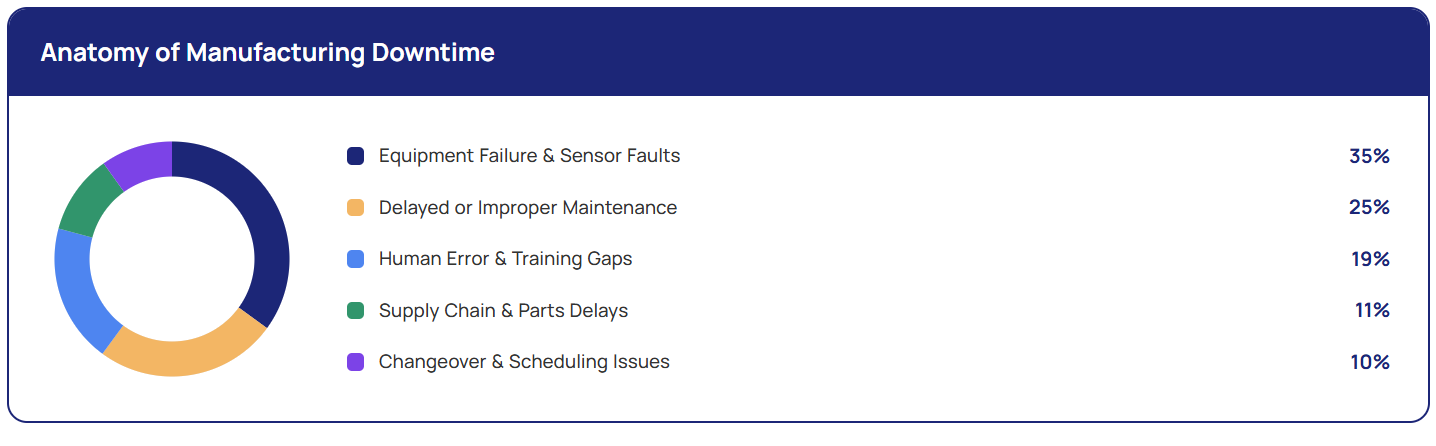
This means 65% of downtime comes from gaps in processes, people, and data not broken machines.
The root causes often come from invisible “blind spots”:
- Unstable networks & data gaps: Machines may be physically fine but lose connection to central systems. This leads to incorrect parameters or delayed maintenance (accounting for up to a quarter of total downtime).
- Information silos: Machines sit idle waiting for materials (11%), waiting for operator input (19%), or waiting for long changeover processes to finish (10%).
No data means no uptime. When data flow is interrupted, operational decisions become guesswork. You detect problems too late, and improving Overall Equipment Effectiveness (OEE) becomes nearly impossible because you’re fighting the wrong enemy.
Automation is the muscle of your factory but data is the nervous system. If the nervous system is disconnected, even the strongest muscles become paralyzed.
2. Data Doesn’t Lie: Lessons from the Litmus Edge Dashboard
Industrial edge computing platforms like Litmus Edge turn downtime from a vague assumption into clear, real-time insights by breaking down production data in a meaningful way, giving you two distinct yet tightly connected perspectives: what’s happening on the shop floor and how it impacts overall business performance.
2.1. Micro View at the Plant Level (Plant Manager Dashboard)
Instead of simply showing “machine downtime,” the system drills deeper into Downtime by Reason.
Real-world examples show that mechanical faults may only account for 20–30% of total downtime. More than 70% of wasted time often comes from:
- Setup: Changeovers taking too long
- Material: Bottlenecks caused by material shortages
- Staffing & Operations: Poor coordination between people and processes
Data shifts the focus away from blaming the maintenance team and toward optimizing the entire operational workflow. You know exactly where to fix the problem to prevent disruptions on the shop floor.
2.2. Macro View for Executives (Executive Dashboard)
Machine data doesn’t stay on the shop floor. It is aggregated and delivered seamlessly to the management level.
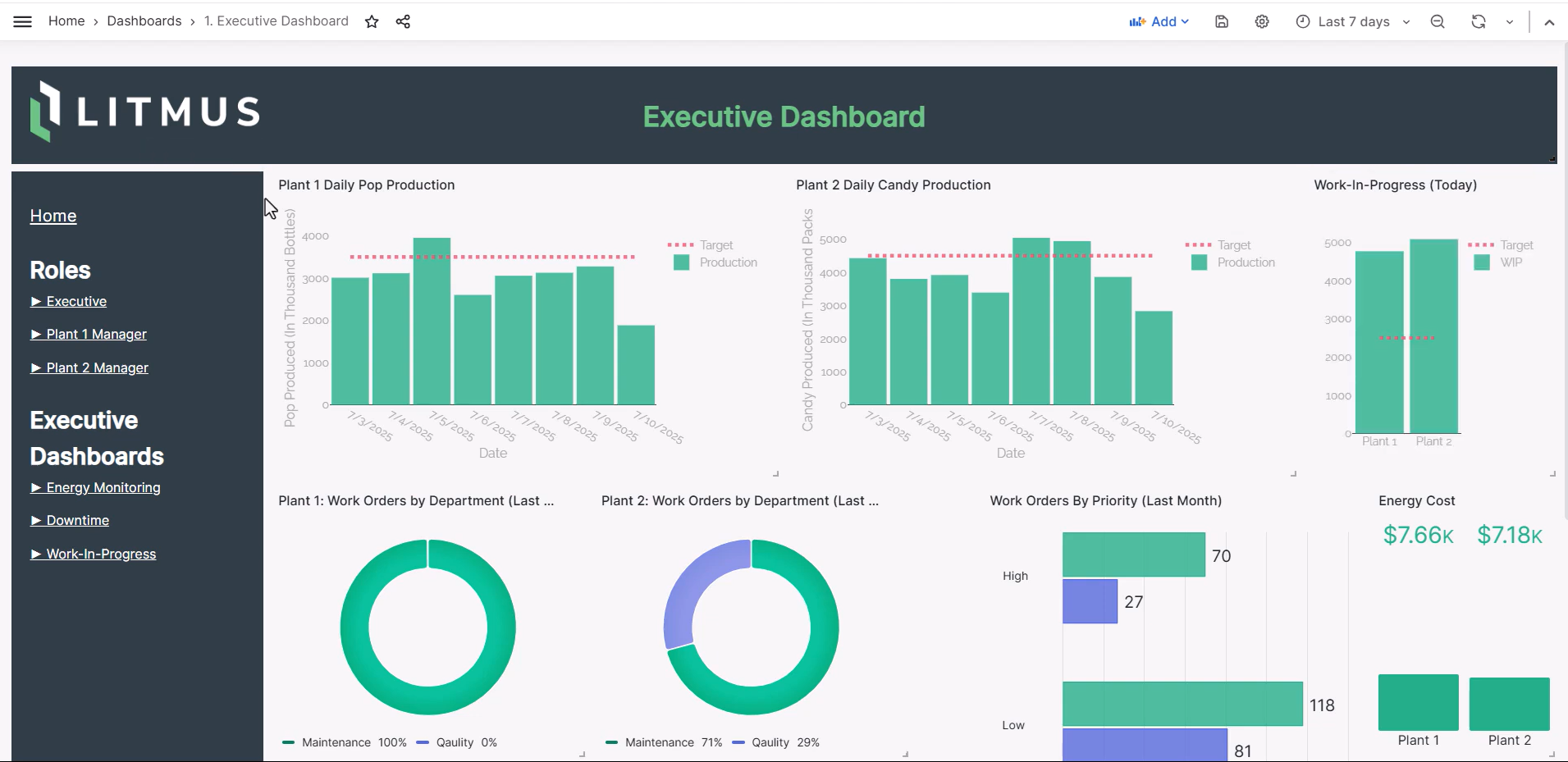
Executives don’t need to walk through every production line to understand performance. The system provides a clear overview of:
- Actual output vs. production targets (Plant 1, Plant 2, etc.)
- Work-in-progress status
- Most importantly, energy costs - directly impacting profit margins
Data bridges the gap between the production line and the boardroom. Strategic decisions are now backed by real-time, transparent numbers not assumptions.
2.3. Industrial Edge: The Backbone of Resilient Automation
To achieve dashboards that truly “tell the truth,” factories need a strong data foundation. Edge solutions are the answer:
- Data collection and normalization at the source: Capture data directly from PLCs and SCADA systems across different machine brands and communication protocols.
- Edge processing: Data is processed locally on-site, enabling instant alerts without waiting for cloud latency.
- Continuous operation: Even if the central internet connection becomes unstable, the edge system continues collecting, storing, and safeguarding data, ensuring the factory’s “nervous system” remains fully operational at all times.
3. Summary
Modern automation is no longer defined by how many robotic arms you install, but by how much clean, reliable data you own and how fast you can turn that data into action to improve Overall Equipment Effectiveness (OEE). The real competitive advantage lies in transforming real-time insights into smarter decisions, faster responses, and continuous optimization.
Ready to move beyond automation and unlock data-driven performance? Let’s start turning your factory data into measurable OEE improvements today.


